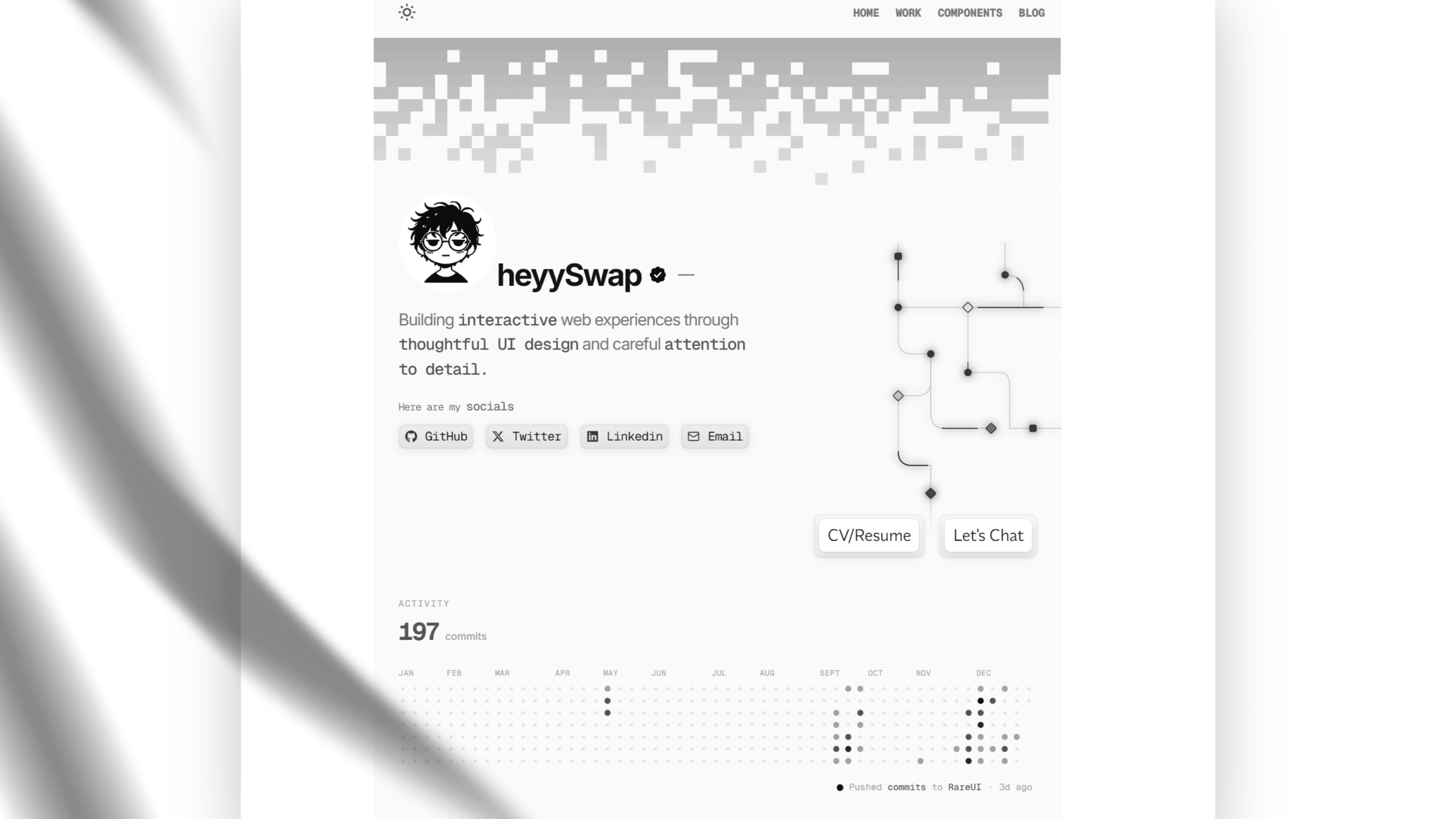
For a long time, I treated my portfolio like most developers do — a static page that lists skills, projects, and a contact button.
Basically, an online resume.
But over time, I realized something important:
A resume tells people what I’ve done.
A product shows people how I think.
That shift changed how I design, build, and iterate on my portfolio.
A Resume Is Read. A Product Is Experienced.
A resume is meant to be scanned:
- Skills
- Experience
- Education
- Links
A product is meant to be used.
When someone opens my portfolio, I don’t want them to just read about my work. I want them to feel it — the attention to detail, the interactions, the decisions.
That’s why I started asking product questions instead of resume questions:
- What’s the first impression?
- Where does the user’s attention go?
- Is this delightful or forgettable?
- What makes this me?
My Portfolio Has Users, Not Viewers
Once I thought of my portfolio as a product, the mindset changed.
Users don’t care about:
- Long tech lists
- Buzzwords
- Perfect layouts
They care about:
- Clarity
- Personality
- Signals of craftsmanship
So I started designing for behavior:
- Subtle animations instead of loud effects.
- Small micro-interactions that reward curiosity.
- Features that feel intentional, not decorative.
Even something playful — like a small cursor interaction — becomes meaningful when it’s designed with restraint and purpose.
Iteration Matters More Than Perfection
Resumes are usually “done.”
Products are never done.
I stopped trying to make my portfolio perfect and started treating it like an evolving system:
- Ship small improvements.
- Remove things that don’t add value.
- Refine copy, motion, and structure over time.
Every iteration teaches me something:
- About UI
- About UX
- About performance
- About restraint
That learning is far more valuable than a polished PDF.
It Shows How I Think, Not Just What I Know
Anyone can list: React, Next.js, Tailwind, Animations.
But a product-style portfolio shows:
- How I structure systems.
- How I handle trade-offs.
- How I think about accessibility.
- How I balance fun with professionalism.
It’s less about saying “I can build things” and more about proving “this is how I build things.”
The Goal Isn’t to Impress Everyone
This was a hard lesson.
- A resume tries to appeal to everyone.
- A product has a point of view.
My portfolio won’t be for everyone — and that’s intentional.
If someone likes:
- Clean UI
- Thoughtful motion
- Small details
- Builder-first thinking
They’ll get it. If not, that’s okay too.
Final Thought
Treating my portfolio like a product made building it more fun — and more honest.
It’s no longer just a place to showcase work. It’s a reflection of how I approach problems, design systems, and ship ideas.
And if someone spends even 30 seconds exploring it and thinks, “Yeah, this feels intentional” — then it’s already doing its job.

Written by HeyySwap
Design Engineer passionate about crafting polished digital experiences. I write about product design, engineering, and the intersection of creativity and logic.